サイズチャート
インターナショナルサイズチャート


Understanding luggage size restrictions is essential for hassle-free travel. Airlines have specific size and weight limits for carry-on and checked baggage that vary by carrier, fare class, and destination. This guide helps you choose the right luggage and avoid expensive fees.
Carry-On Luggage Sizes
Standard Carry-On (22" x 14" x 9" / 56 x 36 x 23 cm): The most widely accepted carry-on size. Fits in overhead bins of most major airlines including American, Delta, United, and international carriers. Weight limit typically 15-22 lbs (7-10 kg).
Personal Item (18" x 14" x 8" / 45 x 35 x 20 cm): Must fit under the seat in front of you. Includes backpacks, laptop bags, and small purses. Most airlines allow one carry-on plus one personal item.
European Carry-On (21.5" x 15.5" x 9" / 55 x 40 x 23 cm): Slightly different dimensions used by Ryanair, easyJet, and other European budget airlines. Always check your specific airline's requirements.
Checked Luggage Sizes
Medium Checked (25" x 18" x 10" / 63 x 46 x 25 cm): Suitable for trips of 1-2 weeks. Typically weighs 15-20 lbs empty. Most airlines allow 50 lbs (23 kg) for economy class.
Large Checked (29" x 20" x 12" / 74 x 51 x 30 cm): For extended trips of 2+ weeks. Typically weighs 20-25 lbs empty. May exceed size limits on some airlines.
Oversized (30"+ any dimension): May incur additional fees ($50-$200). Sports equipment and musical instruments often fall into this category. Check with your airline before traveling.
Airline-Specific Size Limits
Budget Airlines: Often have stricter size limits and charge for carry-on bags. Ryanair, Spirit, and Frontier are known for strict enforcement. Always measure your bag before arriving at the airport.
International Flights: Size limits are generally consistent, but weight limits vary. Asian airlines often have lower weight limits (20kg vs. 23kg for US carriers). Business class typically allows more baggage.
Tips for Choosing Luggage
Invest in a quality carry-on that meets the strictest airline requirements. Hard-shell luggage protects fragile items but adds weight. Soft-shell luggage is more flexible for squeezing into tight spaces. Look for luggage with spinner wheels for easy maneuverability.
Frequently Asked Questions
What happens if my luggage is slightly oversized?
Airlines may charge oversized baggage fees ($50-$200) or require you to check the bag. Some airlines are strict, while others allow minor oversizing. Always check before arriving at the airport.
How do I measure my luggage correctly?
Include wheels and handles in your measurement. Most airlines measure the total external dimensions including all protrusions. Measure length + width + height - this total should not exceed 62 inches (158 cm) for most checked bags.
Luggage Size Chart
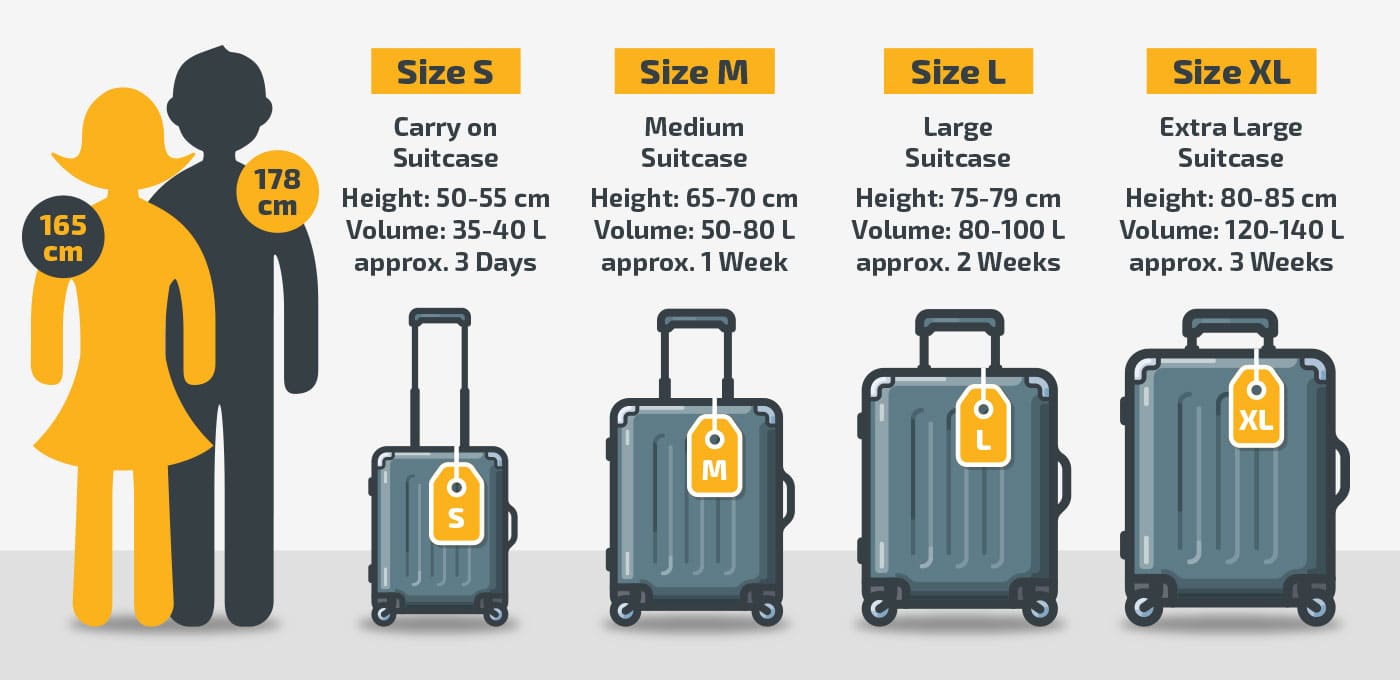
| Size | Suitable Size | Luggage Heigh | Luggage Width | Luggage Thickness |
|---|---|---|---|---|
| S | 18 - 21 inch | 48 - 53 CM | 32 - 36 CM | 20 - 24 CM |
| M | 22 - 24 inch | 58 - 63 CM | 37 - 41 CM | 23 - 27 CM |
| L | 25 - 28 inch | 65 - 70 CM | 42 - 47 CM | 26 - 30 CM |
| XL | 29 - 32 inch | 72 - 80 CM | 48 - 54 inch | 29 - 33 inch |
| Luggage Size Chart Maker : iSizeChart.com | ||||
About Luggage Size Guide Chart
How to choose a suitable luggage ?
Choosing the right luggage depends on your travel needs, preferences, and the type of trip you're taking. Here’s a step-by-step guide to help you pick the best luggage:
1. Determine the Right Size & Capacity.
Carry-On Luggage (20-22" / 50-56 cm) : Best for short trips (2-5 days) or as a supplement to checked luggage. Must comply with airline size restrictions (check your airline’s rules).
Medium Checked Luggage (24-26" / 60-66 cm) : Good for 1-2 week trips.
Large Checked Luggage (28-32" / 70-81 cm) : Ideal for long trips or heavy packers.
2. Choose the Right Type of Luggage.
Softside Luggage (Nylon/Polyester) : Lightweight, flexible, and often have expandable compartments.
Spinner Luggage (4 wheels) : Easy to maneuver in airports (360° rotation).
Rolling Luggage (2 wheels) : More stable on rough surfaces but harder to push long distances.
Backpacks/Duffel Bags : Great for adventure travel, minimalists, or as a personal item.
3. Consider Weight & Durability.
Reinforced corners and strong zippers (e.g., YKK) improve durability.
Look for water-resistant materials if traveling to rainy destinations.
4. Check Important Features.
Expandable zippers for extra packing space.
Multiple compartments for better organization.
Built-in USB ports (if you need to charge devices on the go).
Kind advice:
Best for Business Travel: 22" Carry-On Spinner (e.g., Samsonite Freeform).
Best for Family Vacations: 28" Expandable Hardshell (e.g., Travelpro Maxlite).
Best for Backpackers: 40L Travel Backpack (e.g., Osprey Farpoint).