サイズチャート
インターナショナルサイズチャート


Finding the correct bra size is essential for comfort, support, and breast health. Studies show that up to 80% of women wear the wrong bra size, leading to discomfort, poor posture, and even back pain. This comprehensive guide helps you find your perfect fit.
How to Measure Your Bra Size
Step 1: Measure Your Band Size
Wrap a measuring tape snugly around your ribcage, just under your bust. Keep the tape parallel to the ground. If the measurement is an odd number, round up to the next even number. This is your band size (32, 34, 36, etc.).
Step 2: Measure Your Bust Size
Wrap the tape around the fullest part of your bust, keeping it parallel to the ground. Do not pull tight - the tape should rest gently on your skin. Wear a non-padded bra for accuracy.
Step 3: Calculate Your Cup Size
Subtract your band size from your bust size. Each inch of difference equals one cup size: 1" = A, 2" = B, 3" = C, 4" = D, 5" = DD/E, 6" = DDD/F, 7" = G.
International Bra Size Systems
US/UK: Use inches for band size (32, 34, 36...) and letters for cup size (A, B, C, D, DD, DDD...). UK sizes diverge from US at DD (UK uses E, F, FF, G...).
EU: Uses centimeters for band size (70, 75, 80...) and letters for cup size (A, B, C, D, E, F...). EU band sizes are approximately US band size + 30.
FR/ES: Similar to EU but uses different band size numbering (80, 85, 90...). FR band = EU band + 15.
Signs Your Bra Doesn't Fit
The band rides up in the back (band too large). The cups gap or overflow (wrong cup size). The straps dig into your shoulders (band not providing enough support). The center gore doesn't lie flat against your chest (cup too small). Red marks or discomfort after wearing.
Frequently Asked Questions
How often should I get re-measured?
Get measured at least once a year, or after significant weight changes, pregnancy, or breastfeeding. Your bra size can change over time due to hormonal changes and weight fluctuations.
Why do different brands fit differently?
Bra sizing is not standardized across brands. A 34C in one brand may fit like a 32D in another. Always try on bras or check the brand's specific size chart before purchasing online.
Bra Size Chart
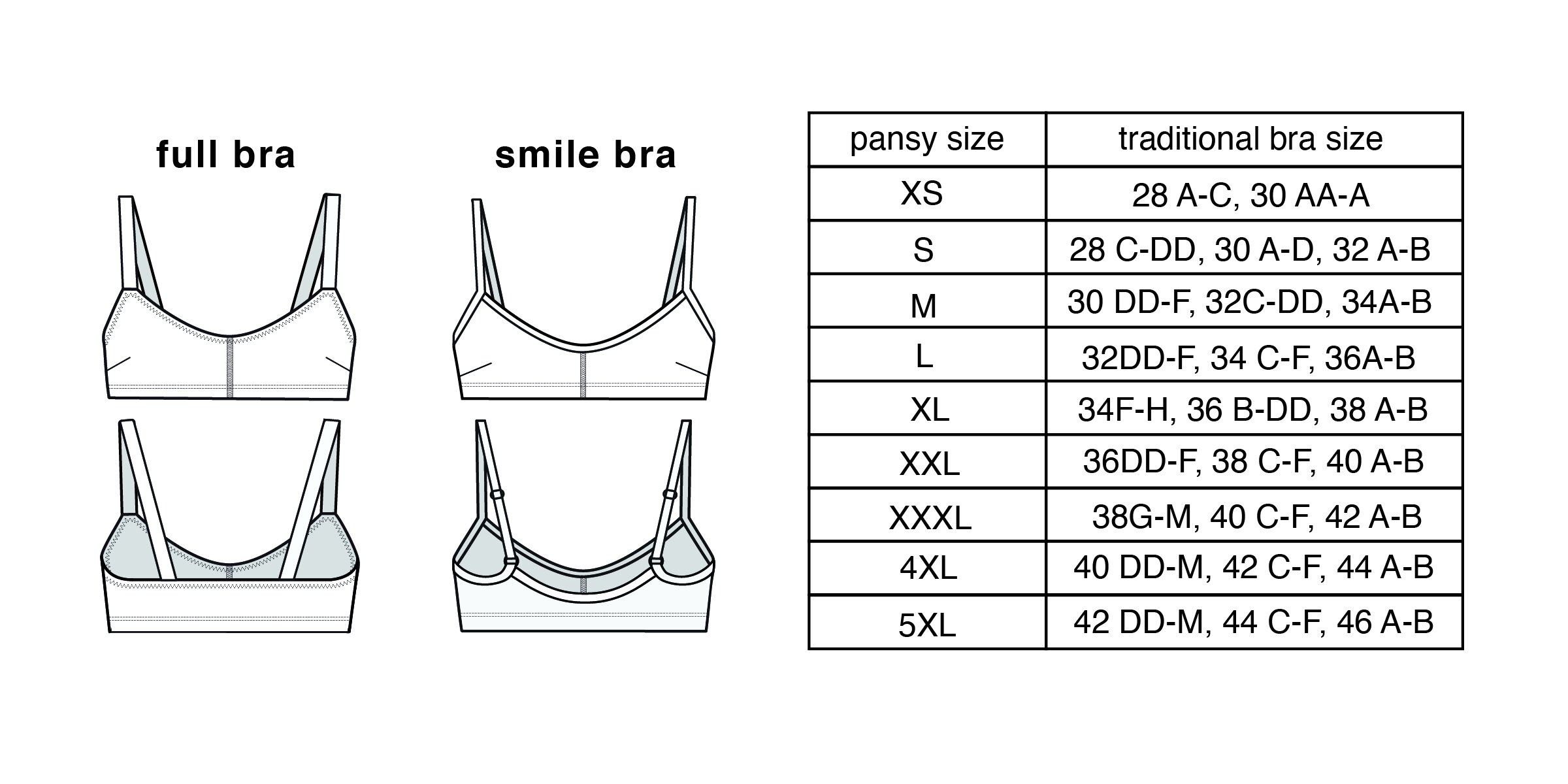
| Band Bifference (in) | US | UK | EU | FR | AU |
|---|---|---|---|---|---|
| < 1 | AA | AA | AA | AA | AA |
| 1 | A | A | A | A | A |
| 2 | B | B | B | B | B |
| 3 | C | C | C | C | C |
| 4 | D | D | D | D | D |
| 5 | DD/E | DD | E | E | DD |
| 6 | DDD/F | E | F | F | E |
| 7 | DDDD/G | F | G | G | F |
| 8 | H | FF | H | H | G |
| 9 | I | G | I | I | H |
| 10 | J | GG | J | J | I |
| 11 | K | H | K | K | J |
| 12 | L | HH | L | L | K |
| 13 | M | J | M | M | L |
| 14 | N | JJ | N | N | M |
| 15 | O | K | O | O | N |
| 16 | P | KK | P | P | O |
| 17 | Q | L | Q | Q | P |
| 18 | R | M | R | R | LL |
| Bra Size Chart Maker : iSizeChart.com | |||||
About Bra Size Guide Chart
Ⅰ. Classification of bras
Bras can be classified based on various factors, including style, support level, coverage, function, and material.
1. By Support Level.
Medium Support – T-shirt bras, balconette bras (everyday wear).
High Support – Sports bras, full-coverage bras, minimizer bras (for larger busts or intense activity).
Maximum Support – Encapsulation sports bras, structured underwire bras (for high-impact workouts or heavy busts).
2. By Coverage & Style.
Balconette (Balcony) – Lower cut, wide-set straps, enhances lift.
Plunge – Deep neckline for low-cut tops.
Demi-Cup – Half-coverage, slightly revealing.
Strapless/Convertible – Multiway bras with removable straps.
Push-Up – Padded to enhance cleavage.
Bralette – Unlined, wireless, often lace-based.
3. By Function.
Maternity/Nursing Bras – Designed for breastfeeding.
Post-Surgical Bras – For recovery after breast surgery.
Minimizer Bras – Reduces bust appearance.
T-Shirt Bras – Seamless for tight clothing.
Adhesive/Stick-On Bras – Backless or strapless outfits.
4. By Material & Construction.
Lace Bras – Aesthetic, often less supportive.
Silk/Satin Bras – Luxurious feel.
Mesh Bras – Lightweight, breathable.
Padded/Molded Cups – Foam-lined for shape.
Unpadded/Soft Cups – Natural shape.
5. By Strap & Closure Type.
Halter Neck – Straps tie behind the neck.
Front-Closure – Clasps in the front.
Back-Closure – Traditional hook-and-eye back.
Wirefree – No underwire for comfort.
Underwire – Provides structure and lift.
II. How to choose a suitable bra based on chest shape ?
Choosing the right bra based on your breast shape ensures better support, comfort, and a flattering fit. Here’s a guide to help you match bras to different breast shapes:
1. Round (Even Fullness on Top & Bottom).
T-shirt bras (smooth look).
Balconette bras (enhance shape).
Push-up bras (if desired).
2. Teardrop (Fuller at Bottom, Tapered at Top).
Push-up bras (enhances top).
Demi-cup bras (gives slight lift).
Lightly padded bras (balances shape).
3. East-West (Breasts Point Outward, Wide-Set).
Front-closure bras (pulls breasts together).
Plunge bras (centers cleavage).
Side-support bras (inner slings help).
4. Asymmetric (One Breast Larger Than the Other).
Stretch-lace bras (molds to shape).
Removable-pad bras (adjust padding).
Unlined bras (flexible fit).
5. Bell Shape (Slender Top, Full Bottom).
Full-coverage bras (prevents sagging).
Underwire bras (lifts heavy bottom).
Minimizer bras (if desired).
6. Athletic (Wider Torso, Less Projection).
Sports bras (high-impact for support).
Bralettes (if minimal support needed).
Racerback bras (broader shoulders).
7. Close-Set (Little Space Between Breasts).
Plunge bras (avoids gapping).
Low-gore bras (prevents digging).
J-hook convertible bras (adjustable straps).
8. Relaxed/Sagging (More Skin, Less Fullness).
Full-coverage bras (holds securely).
Underwire bras (provides structure).
Seamless uplift bras (smooth silhouette).