internationale Größentabelle


Choosing the right TV size depends on your room dimensions, viewing distance, and content preferences. This comprehensive guide helps you find the perfect TV size for your space and budget.
How TV Sizes Are Measured
TV sizes are measured diagonally from corner to corner of the screen. A 55-inch TV has a 55-inch diagonal measurement. The actual width and height depend on the aspect ratio - modern TVs use 16:9 (widescreen).
Common TV Sizes and Dimensions (16:9 Aspect Ratio)
32-inch TV: Approximately 28" wide x 16" tall (71 x 41 cm). Ideal for bedrooms, kitchens, and small spaces. Best viewed from 4-7 feet away.
43-inch TV: Approximately 38" wide x 21" tall (96 x 54 cm). Great for small living rooms and bedrooms. Best viewed from 5-9 feet away.
50-inch TV: Approximately 44" wide x 25" tall (111 x 63 cm). Popular mid-size option for medium rooms. Best viewed from 6-10 feet away.
55-inch TV: Approximately 48" wide x 27" tall (122 x 69 cm). The most popular size for living rooms. Best viewed from 7-11 feet away.
65-inch TV: Approximately 57" wide x 32" tall (145 x 81 cm). Ideal for large living rooms and home theaters. Best viewed from 8-13 feet away.
75-inch TV: Approximately 65" wide x 37" tall (165 x 94 cm). For dedicated home theater rooms. Best viewed from 10-15 feet away.
85-inch TV: Approximately 74" wide x 42" tall (188 x 107 cm). Premium large-screen experience. Best viewed from 11-17 feet away.
Optimal Viewing Distance Formula
For 4K TVs: Multiply the screen size (diagonal inches) by 1.2 to get the optimal viewing distance in inches. For example, a 55-inch 4K TV is best viewed from about 66 inches (5.5 feet) away.
For 1080p TVs: Multiply the screen size by 1.5-2.5 for the optimal viewing distance. A 55-inch 1080p TV is best viewed from 7-11 feet away.
Room Size Recommendations
Small room (under 10x10 feet): 32-43 inch TV. Medium room (10x12 to 12x15 feet): 50-55 inch TV. Large room (15x20 feet or larger): 65-75 inch TV. Home theater (dedicated room): 75-85+ inch TV.
Frequently Asked Questions
Is bigger always better for TVs?
Not necessarily. A TV that's too large for your viewing distance can cause eye strain and make individual pixels visible. Follow the recommended viewing distance guidelines for the best experience.
Should I consider 4K vs 8K when choosing size?
4K resolution allows you to sit closer to larger screens without seeing pixels. For screens 65 inches and above, 4K is strongly recommended. 8K is currently only beneficial for screens 75 inches and larger.
TV Size Chart
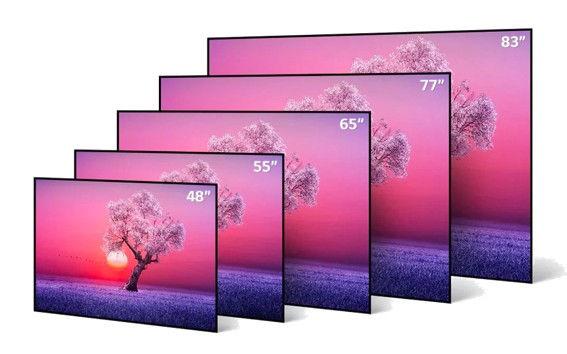
| TV Size | Width | Height | Area | ||||||
|---|---|---|---|---|---|---|---|---|---|
| inches | inches | cm | inches | cm | in² | m² | |||
| 32 | 27.9 | 70.9 | 15.7 | 39.9 | 438 | 0.283 | |||
| 40 | 34.9 | 88.6 | 19.6 | 49.8 | 684 | 0.441 | |||
| 43 | 37.5 | 95.3 | 21.1 | 53.6 | 791 | 0.511 | |||
| 50 | 43.6 | 110.7 | 24.5 | 62.2 | 1068 | 0.689 | |||
| 55 | 47.9 | 121.7 | 27 | 68.6 | 1293 | 0.835 | |||
| 60 | 52.3 | 132.8 | 29.4 | 74.7 | 1538 | 0.992 | |||
| 65 | 56.7 | 144 | 31.9 | 81 | 1809 | 1.166 | |||
| 70 | 61 | 154.9 | 34.3 | 87.1 | 2092 | 1.349 | |||
| 75 | 65.4 | 166.1 | 36.8 | 93.5 | 2407 | 1.553 | |||
| 80 | 69.7 | 177 | 39.2 | 99.6 | 2732 | 1.763 | |||
| 85 | 74.1 | 188.2 | 41.7 | 105.9 | 3090 | 1.993 | |||
| 98 | 85.4 | 216.9 | 48 | 121.9 | 4099 | 2.644 | |||
| 100 | 87.2 | 221.5 | 49 | 124.5 | 4273 | 2.758 | |||
| 110 | 95.9 | 243.6 | 53.9 | 136.9 | 5169 | 3.335 | |||
| 115 | 100.2 | 254.5 | 56.4 | 143.3 | 5651 | 3.647 | |||
| TV Size Chart Maker : iSizeChart.com | |||||||||
| TV Size | Minimum distance for 4K TV | Minimum distance for 1080p TV | |||||||
|---|---|---|---|---|---|---|---|---|---|
| 40 inches | 40 inches (3.3 feet) | 80 inches (6.7 feet) | |||||||
| 42 inches | 42 inches (3.5 feet) | 84 inches (7 feet) | |||||||
| 48 inches | 48 inches (4 feet) | 96 inches (8 feet) | |||||||
| 50 inches | 50 inches (4.2 feet) | 100 inches (8.3 feet) | |||||||
| 55 inches | 55 inches (4.6 feet) | 110 inches (9.2 feet) | |||||||
| 60 inches | 60 inches (5 feet) | 120 inches (10 feet) | |||||||
| 65 inches | 65 inches (5.4 feet) | 130 inches (10.8 feet) | |||||||
| 75 inches | 75 inches (6.25 feet) | 150 inches (12.5 feet) | |||||||
| 85 inches | 85 inches (7.1 feet) | 170 inches (14.2 feet) | |||||||
| TV Size Chart Maker : iSizeChart.com | |||||||||
About TV Size Chart
How to choose TV size and viewing distance?
Choosing the right TV size and viewing distance depends on several factors, including screen resolution, room size, and personal preference. Here’s a guide to help you decide:
1. TV Size Based on Viewing Distance.
Regarding TV size and viewing distance, see the table above.
For 1080p TVs: Sitting too close may reveal pixelation.
For 4K TVs: You can sit closer (~1–1.5x screen height) without losing clarity due to higher resolution.
For 8K TVs: You can sit even closer (~0.75x screen height).
2. Consider Room Size & Layout.
Medium rooms (e.g., living rooms) → 55"–65"
Large rooms/open spaces → 65"–85"+
Home theaters → Projectors or 75"+ TVs
3. TV Height & Eye Level.
If wall-mounted above a fireplace, consider a tilting mount to reduce neck strain.
4. Field of View & Immersion.
For casual viewing, a 20°–30° field of view is comfortable.
5. Personal Preference & Usage.
Sports/Movies: Bigger screens with wider viewing angles improve the experience.
Mixed use (TV, streaming, gaming): Balance size and resolution (4K is ideal for 55" and above).
For a balanced experience, Reference experience:
Minimum distance = TV height × 1.5
Maximum distance = TV height × 2.5