international size chart


The A series is the most widely used paper size system in the world, defined by the ISO 216 standard. All A sizes share the unique property that folding any size in half produces the next smaller size with identical proportions.
Complete A Series Dimensions
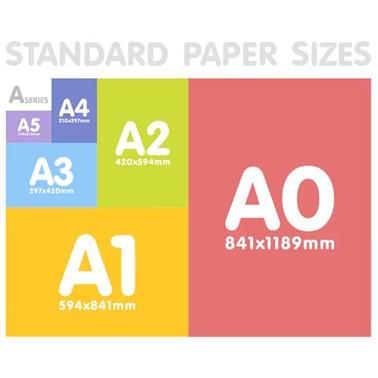
A0: 841 x 1189 mm (33.1 x 46.8 inches). Area: 1 square meter. Used for large posters and technical drawings.
A1: 594 x 841 mm (23.4 x 33.1 inches). Half of A0. Used for flip charts and architectural drawings.
A2: 420 x 594 mm (16.5 x 23.4 inches). Half of A1. Popular for medium posters and diagrams.
A3: 297 x 420 mm (11.7 x 16.5 inches). Half of A2. Common for spreadsheets and small posters.
A4: 210 x 297 mm (8.3 x 11.7 inches). Half of A3. The standard office paper worldwide.
A5: 148 x 210 mm (5.8 x 8.3 inches). Half of A4. Used for notebooks and flyers.
A6: 105 x 148 mm (4.1 x 5.8 inches). Half of A5. Used for postcards.
A7: 74 x 105 mm (2.9 x 4.1 inches). Half of A6. Used for small notes and tickets.
A8: 52 x 74 mm (2.0 x 2.9 inches). Half of A7. Used for business cards in some countries.
The Mathematics Behind A Sizes
All A sizes have an aspect ratio of 1:√2 (approximately 1:1.414). This means when you fold an A-size paper in half parallel to its shorter side, you get the next smaller size with the same proportions. This property makes scaling between sizes distortion-free.
A4 vs. US Letter
A4 (210 x 297 mm) is slightly taller and narrower than US Letter (216 x 279 mm). This difference can cause formatting issues when sharing documents between regions. Most modern software handles both sizes automatically.
Frequently Asked Questions
Why is A4 the international standard?
A4's 1:√2 ratio allows seamless scaling between sizes. This makes it ideal for copying, printing, and digital document exchange across different formats.
What paper size should I use for international business?
Use A4 for most international documents. If sending to the US, consider providing both A4 and Letter versions to ensure compatibility.
Series A Paper Size Chart
| A Paper Size | Dimensions (inches) | Dimensions (mm) | Area (mm²) | ||||||
|---|---|---|---|---|---|---|---|---|---|
| A0 Size | 33.1 × 46.8 | 841 × 1189 | 999949 | ||||||
| A1 Size | 23.4 × 33.1 | 594 × 841 | 499554 | ||||||
| A2 Size | 16.5 × 23.4 | 420 × 594 | 249480 | ||||||
| A3 Size | 11.7 × 16.5 | 297 × 420 | 124740 | ||||||
| A4 Size | 8.3 × 11.7 | 210 × 297 | 62370 | ||||||
| A5 Size | 5.8 × 8.3 | 148 × 210 | 31080 | ||||||
| A6 Size | 4.1 × 5.8 | 105 × 148 | 15540 | ||||||
| A7 Size | 2.9 × 4.1 | 74 × 105 | 7770 | ||||||
| A8 Size | 2 × 2.9 | 52 × 74 | 3848 | ||||||
| A9 Size | 1.5 × 2 | 37 × 52 | 1924 | ||||||
| A10 Size | 1 × 1.5 | 26 × 37 | 962 | ||||||
| Series A Paper Size Chart Maker : iSizeChart.com | |||||||||
About Series A Paper Size Chart
How are the A series paper sizes defined?
The A series paper sizes are defined by the ISO 216 international standard and are based on a few key principles:
①. A0 Starting Point: The largest size, A0, has an area of 1 square meter (1 m²).
②. Constant Aspect Ratio: All sizes maintain the same aspect ratio (width:height) of 1:√2 (approximately 1:1.4142). This is the unique ratio where halving the longer side produces the next smaller size with the same ratio.
③. Halving Rule: Each subsequent size (A1, A2, A3, etc.) is defined by halving the longer side of the previous size:
A1 is half of A0; A2 is half of A1; A3 is half of A2; ...and so on.
1. How this works mathematically.
Width (w) x Height (h) = 1 m²
h = w * √2
Substitute: w * (w * √2) = 1 => w² * √2 = 1 => w² = 1/√2
Solving gives: Width (w) = 841 mm (rounded to nearest mm); Height (h) = 1189 mm (rounded to nearest mm); A0 = 841 mm × 1189 mm
②. Deriving Smaller Sizes: Halve the longer side (height) of A0 to get A1:
A1 height = A0 width = 841 mm
A1 width = A0 height / 2 = 1189 / 2 = 594.5 mm ≈ 594 mm (rounded)
A1 = 594 mm × 841 mm
③. Continue Halving:
A2 height = A1 width = 594 mm; A2 width = A1 height / 2 = 841 / 2 = 420.5 mm ≈ 420 mm; A2 = 420 mm × 594 mm
A3 height = A2 width = 420 mm; A3 width = A2 height / 2 = 594 / 2 = 297 mm; A3 = 297 mm × 420 mm
A4 height = A3 width = 297 mm; A4 width = A3 height / 2 = 420 / 2 = 210 mm; A4 = 210 mm × 297 mm
...and so on down to A10.
2. Key Characteristics & Advantages.
Efficiency: The halving rule simplifies production, trimming, and folding. Two A4 sheets fit perfectly onto one A3 sheet, four onto one A2, etc.
International Standardization: Used in most countries worldwide (except primarily the US, Canada, Mexico, and the Philippines), ensuring compatibility for printing, copying, envelopes, and office supplies.
Tolerances: ISO 216 specifies allowable dimensional tolerances (typically ±1.0 mm or ±1.5 mm for dimensions over 150 mm, ±0.5 mm for smaller dimensions) and tolerances for squareness and edge straightness.
Rounding: Dimensions are always specified in whole millimeters (mm).
Origin: The underlying principle (the 1:√2 aspect ratio) was first proposed by Georg Christoph Lichtenberg in 1786. France adopted it as a standard in the late 18th/early 19th century, and it was later formalized internationally as DIN 476 (Germany) in 1922 and then ISO 216 in 1975.
This elegant mathematical definition creates a highly practical and efficient system for paper sizes.